Admitting the Heresy: Jordanville's Public Confession Against the Moscow Patriarchate

Apr 23
5 min read
Subdeacon Nektarios, M.A.
On April 15th, 2026, Bishop Luke, the abbot of Holy Trinity Monastery in Jordanville, New York, made a public statement addressing his own Moscow Patriarchate and its ecumenist activities with the ecumenically condemned Monophysite jurisdictions. In this two-paragraph introduction to an academic research paper detailing why the Monophysites are, in fact, ecumenically condemned, outside of the Orthodox Church, and heretical, he issues a direct and public criticism of actions associated with the Moscow Patriarchate. In this short introduction to his research article on the Monophysites, Bishop Luke writes:
Recently in India, a greeting was sent to Monophysites by an Orthodox Patriarch supporting them by claiming that their heretical church is the same Church our Saviour spoke of when He said the gates of hell would not prevail against it. These and similar gatherings and statements only add to the confusion and scandal of the Faithful. Any attempt to clarify and defend the dogma of the Church is dismissed as ‘Romantic theology’ [1].
What he is referring to here is a recent event conducted by the Moscow Patriarchate’s Department for External Church Relations (DECR), whose plenipotentiary representatives act officially in the name of the Patriarchate and its Synod. This event, discussed in my article, “The Fourth Ecumenical Council: The Moscow Patriarchate’s Official Rejection & Nullification of its Dogmatic Decree,” involved participation alongside the Malankara Monophysites and included statements that were a de facto rejection of the Fourth Ecumenical Council and its decree concerning the heretical Monophysites.
At this heretical event, Metropolitan Anthony, acting as an official representative of the Moscow Patriarchate through the DECR, delivered the following address to the Malankara Monophysites:
Your Holiness and dear brothers, Bishops, dear Fathers, brothers and sisters in Christ, It is a true honor and a privilege for us, the representatives of the Russian Orthodox Church, to be here with you today, and we have brought you sincere greetings and regards from His Holiness, Patriarch of Moscow and All Russia, Kyrill, his love to His Holiness the Catholicos, with whom they have been friends for many years, since the time when His Holiness was a student of the Leningrad Theological Seminary and Academy, the love of our Patriarch towards your ancient church.
And it is a great honor for us to be here, especially on this special occasion of the blessing of the holy chrism, which is presented as a sign of the words of our Lord Jesus Christ, who said that He would found His Church and that even the gates of hell would not prevail against it. This is described as a sign that the church continues its life, continues its ministry, and continues to bring the Gospel to new generations of Christians in this land.
On behalf of the Russian Orthodox Church, I would like to wish all of you many blessings of our Lord Jesus Christ, so that the Malankara Orthodox Church, for many years to come, will continue its ministry to bring the Gospel of Christ to the people here in India and worldwide.
Thank you so much for the invitation and the opportunity to be here with you today. Thank you [2].
Bishop Luke does not explicitly name the Moscow Patriarchate in his statement, nor does he directly identify this specific event. Nevertheless, his remarks may reasonably be understood as a pointed condemnation of precisely this kind of ecumenist activity, especially when such activity appears to confer ecclesial legitimacy upon Monophysite bodies condemned by the Orthodox Church. From an Orthodox Christian standpoint, such language is not a harmless diplomatic gesture, but a grave theological scandal, since it fundamentally obscures the dogmatic boundaries established by the Ecumenical Councils.
The significance of Bishop Luke’s statement is that it exposes, however indirectly, the unresolved contradiction at the heart of ROCOR-MP after the union of 2007. Those who warned against that union argued from the beginning that ROCOR was being joined to a patriarchate already compromised by the heresies of Sergianism and Ecumenism. Bishop Luke’s words now confirm, in substance if not by explicit name, what the true remnant of ROCOR and the Genuine Orthodox Christians of Greece have been saying for nineteen years: that the Moscow Patriarchate’s ecumenist engagements are not isolated diplomatic gestures, but manifestations of deeper ecclesiological heresies.
Holy Trinity Monastery’s statement is therefore significant because it openly recognizes the very heresy that places ROCOR-MP under the 1983 Anathema Against Ecumenism, as Bishop Gabriel himself acknowledged in his 2007 deposition video. If the Moscow Patriarchate’s conduct toward the Monophysites is scandalous and contrary to Orthodox dogma, then those who remain in communion with that patriarchate cannot pretend that the matter is external to them. The question is no longer whether ecumenism exists somewhere else, but why do those who recognize the heresy continue to remain within a jurisdiction that publicly participates in it.
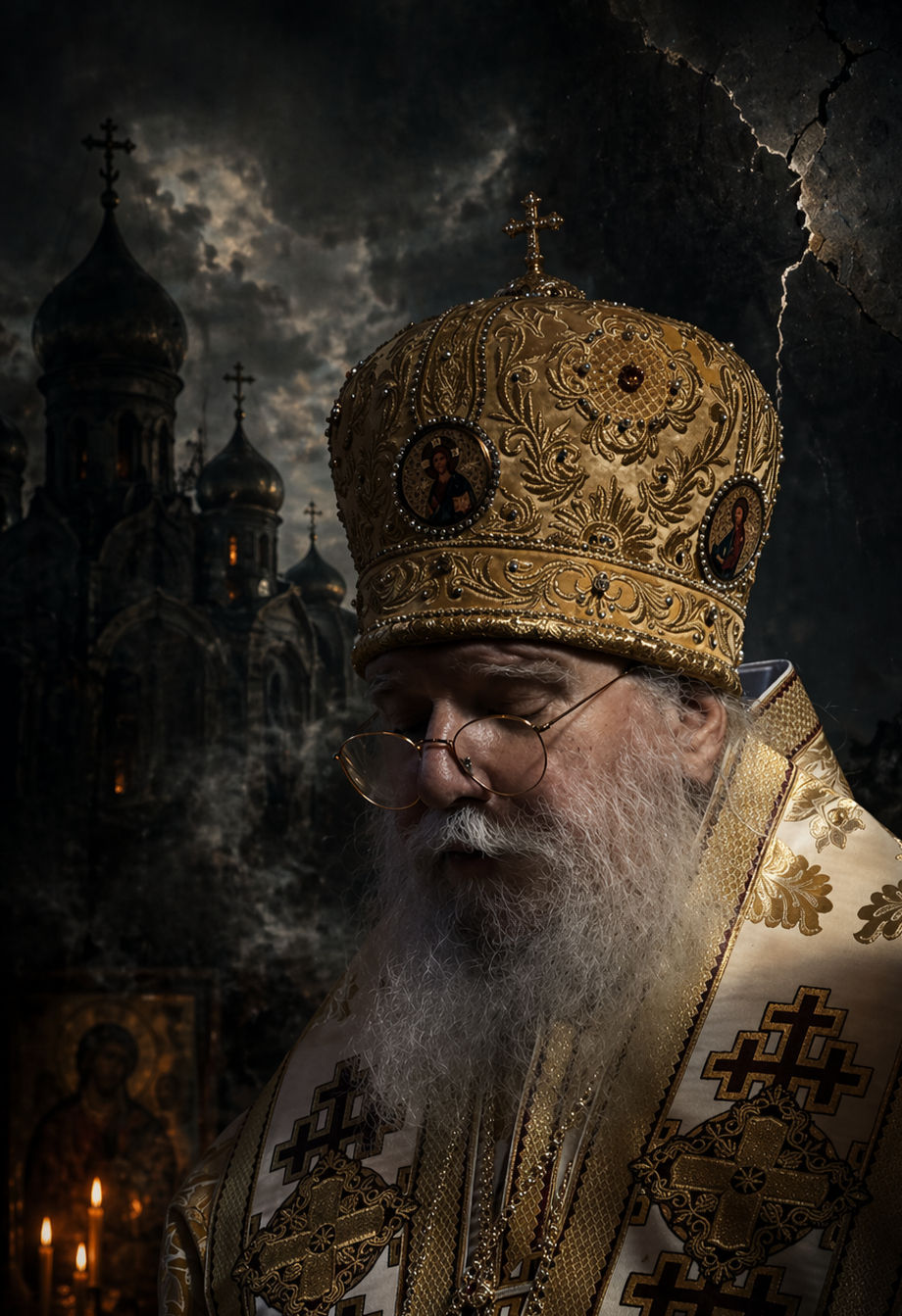
For this reason, Bishop Luke’s statement cannot be dismissed as a passing remark. He is regarded by many as one of the only hierarchs within ROCOR-MP who can even remotely be described as Orthodox in any confessional sense. Yet if his warning is to carry any real weight, it cannot remain a cautious criticism from within a compromised communion. A denunciation of heresy becomes hollow when the one making it continues to stand liturgically and ecclesiastically with the very patriarchate advancing that heresy. This is precisely why the legacy of Metropolitan Vitaly (Ustinov) and the earlier confessional witness of ROCOR remain so important. The old ROCOR stood against Sergianism, Ecumenism, and compromise with heretics, while the post-2007 ROCOR-MP placed that witness under the very Moscow Patriarchate it once resisted. Defenders of the union may dispute this judgment, but they cannot erase the visible consequences of the reconciliation. What was once a confessing Church now condemns, from within, the very ecclesiastical system to which it has subjected itself.
Let Bishop Luke’s statement therefore stand as a sober warning, but also as a merciful summons, to those who remain within ROCOR-MP. If even one of their own bishops now publicly identifies the scandal of ecumenist heresy within the Moscow Patriarchate, then the faithful, and those clergy who still possess an Orthodox conscience, should receive his words as a providential call to act. The matter is no longer hidden, distant, or unclear. It is now placed before them openly. They must flee communion with a patriarchate that advances such ecclesiological heresies and return to the confession of Orthodoxy still preserved by the Genuine Orthodox Church of Greece and by the Russian Orthodox Church Abroad under Metropolitan Agafangel, the only synodal bishop who refused to follow ROCOR into the union of 2007.
This is not a call to despair, but to repentance, courage, and return. Nor is it a call to enter another compromised jurisdiction, equally guilty of ecumenist participation and entangled in the World Council of Churches, but to come back to the Orthodox confession preserved without compromise. The issue is not sentiment, nostalgia, or institutional loyalty, but fidelity to the Orthodox Faith and obedience to the apostolic command: “Now we command you, brethren, in the name of our Lord Jesus Christ, to withdraw yourselves from every brother walking disorderly and not according to the tradition which they received from us” (2 Thessalonians 3:6).


Comments